Impacting the Community
Designing for Learning, Faith, and Community at Mission Grammar School
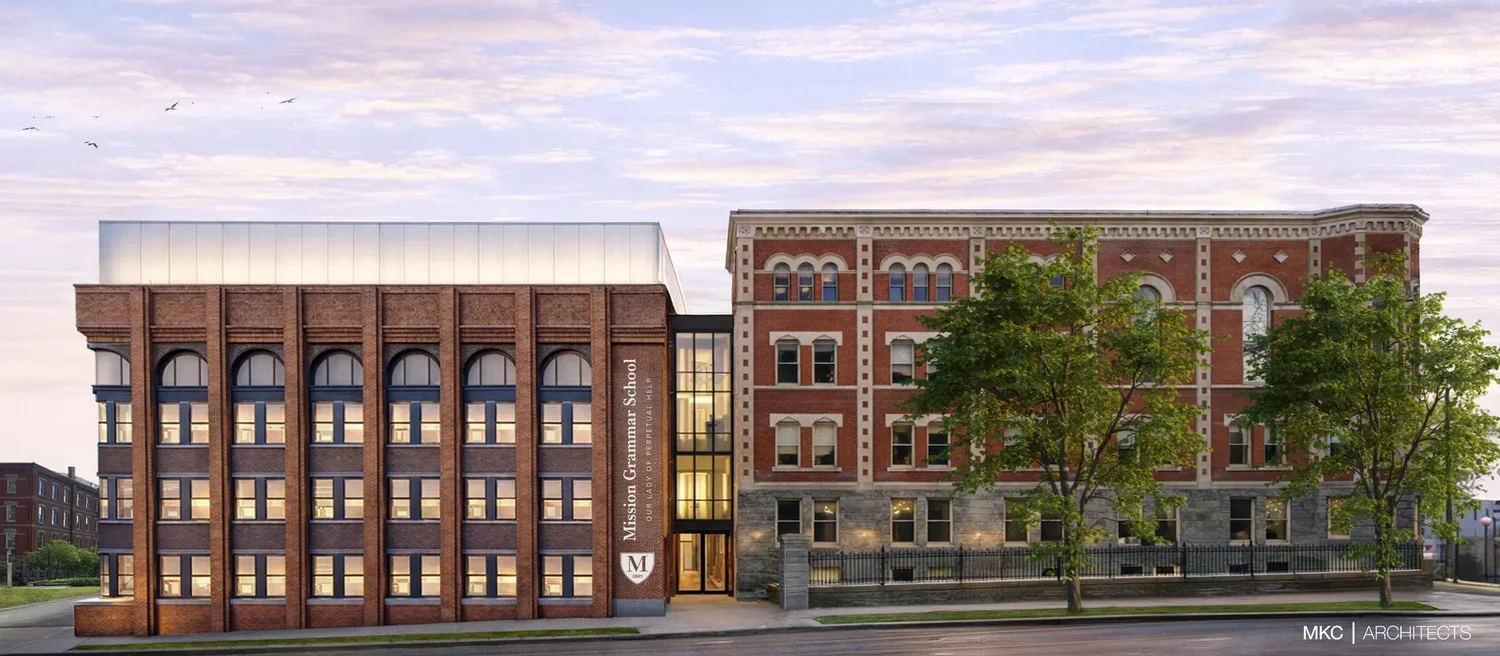
On March 5, 2026, Mission Grammar School broke ground on the first phase of a multi-phase campus transformation in Boston’s Mission Hill neighborhood, marking a pivotal moment for one of the city’s most enduring educational institutions. For a school with a legacy that stretches back generations, the ceremony was more than the start of construction. It was the visible beginning of a larger commitment to renewal, one rooted in the belief that the design of a school can shape not only how students learn, but how a community gathers, identifies itself, and looks toward the future.
The milestone also carries particular meaning for MKC Architects as we continue to expand our presence in Boston through our new office there. That local foothold strengthens our ability to serve mission-driven institutions across the region with greater proximity, responsiveness, and engagement. Boston is a city where education, faith, and civic life have long been intertwined, and our work at Mission Grammar reflects precisely that intersection. As a firm with a longstanding commitment to institutions that shape public life, we see this project not simply as a building effort, but as an investment in the cultural and spiritual fabric of a neighborhood.
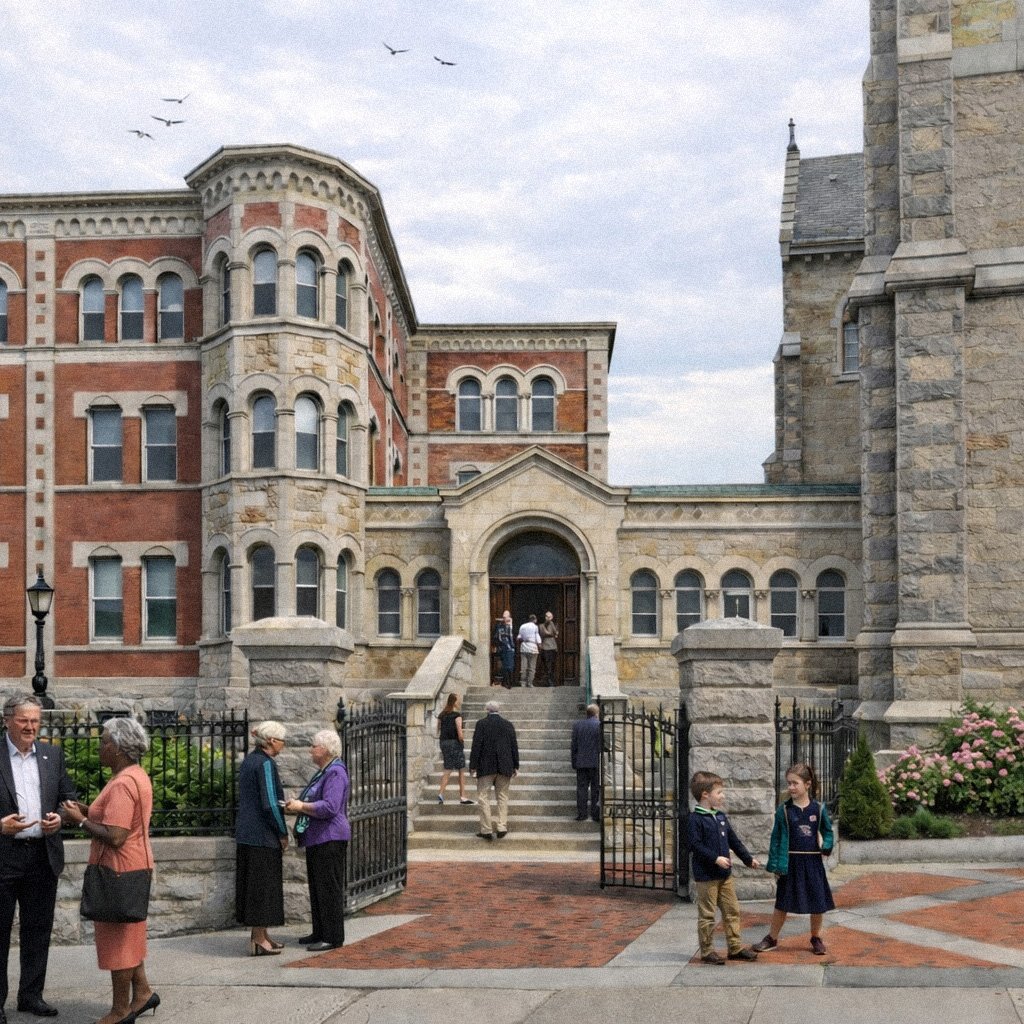
Mission Grammar is not just another school. It is the oldest operating school in the city of Boston, an institution whose identity is inseparable from the history of Mission Hill and from its deep relationship to Our Lady of Perpetual Help and the Redemptorist tradition. Its longevity gives the current work a special weight. Any intervention on a campus like this must do more than solve practical needs. It must honor an inheritance while preparing the institution to meet the demands of a new era. That is the challenge and the opportunity of this project.
Too often, conversations about school design are reduced to utilitarian concerns such as area requirements, circulation efficiency, or maintenance needs. Those matters are important, but they do not fully account for the true influence architecture exerts on educational life. A school building is not a neutral container. It shapes habits, relationships, expectations, and aspirations. It influences how welcomed a family feels upon arrival, how confidently a child moves through the day, how teachers collaborate, and how a broader community perceives the institution’s value. In this sense, school design is never merely technical. It is cultural, civic, and deeply human.
At Mission Grammar, that reality is especially clear. Situated within one of Boston’s most historic neighborhoods, the campus occupies a setting defined by memory, faith, and continuity. The project begins from the understanding that the campus is not simply a collection of buildings, but a place of encounter. It has long served scholars, parishioners, and families not only as a site of instruction, but as a locus of belonging and formation. The task, therefore, is not to impose novelty onto a historic institution, but to renew the campus in a way that preserves its identity while expanding its capacity to serve future generations.
The Landing
This is why the Mission Grammar project is best understood as more than a renovation. It is a comprehensive reimagining of how the campus can better support learning, faith formation, and community life. The existing rectory is approached with care and restraint, preserving its traditional character and continuity with the historic parish setting. The school building, by contrast, becomes the site of more visible transformation through thoughtful additions and exterior interventions that bring renewed clarity and presence to the campus. Together, these moves create a stronger relationship between old and new, allowing each component to maintain its integrity while participating in a more legible and unified whole.
One of the project’s most important contributions lies in how it redefines arrival, identity, and campus organization. The proposal creates a clearer distinction between parish and school functions, organizing uses by building and purpose so that each can operate with greater clarity while still remaining connected to the broader campus mission. This distinction is not merely practical. It also has symbolic importance. When entrances are clear, when circulation is intuitive, and when each component of a campus expresses its own identity, the institution becomes easier to understand and more welcoming to all who enter it. Architecture, in this sense, becomes a form of hospitality.
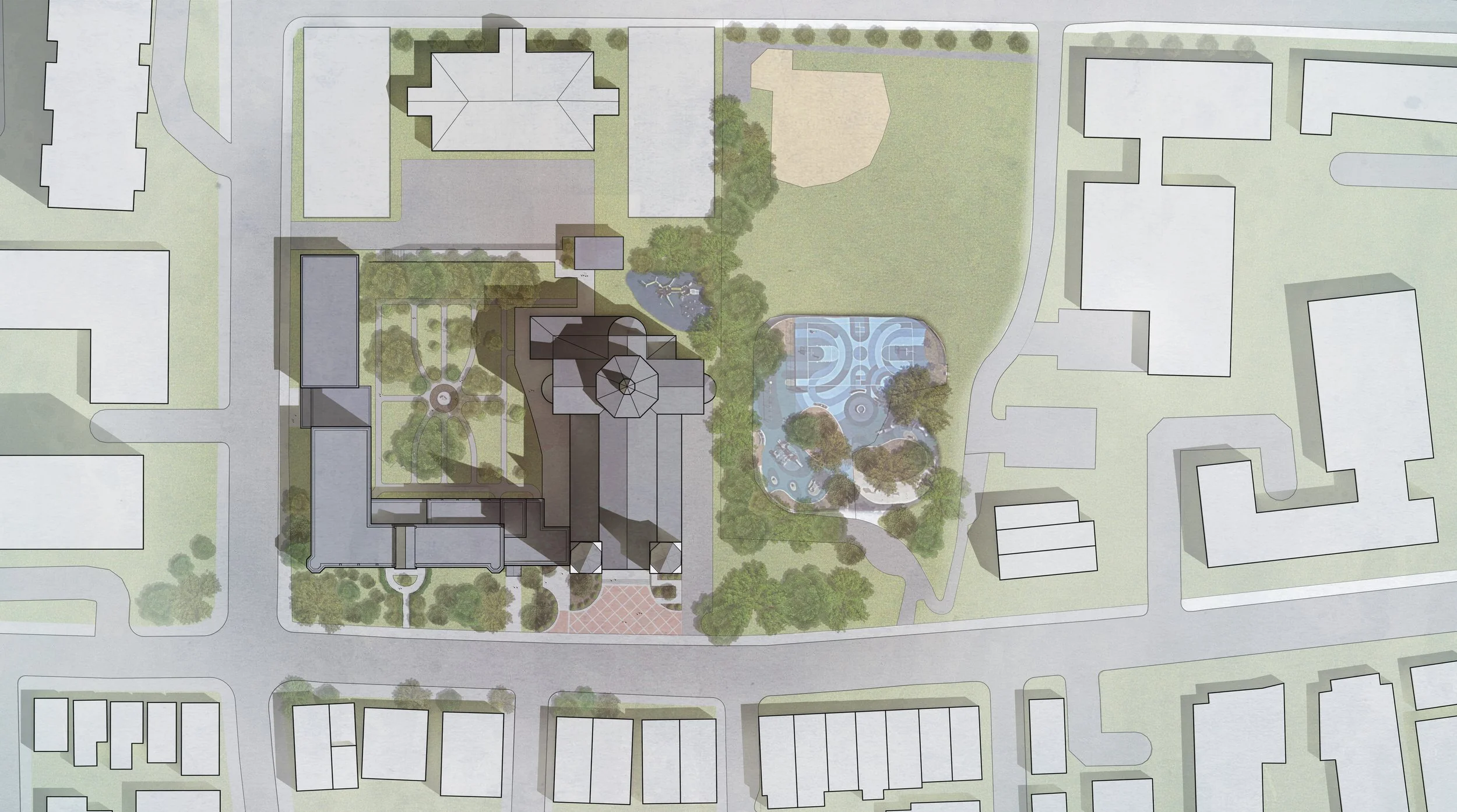
Site Plan
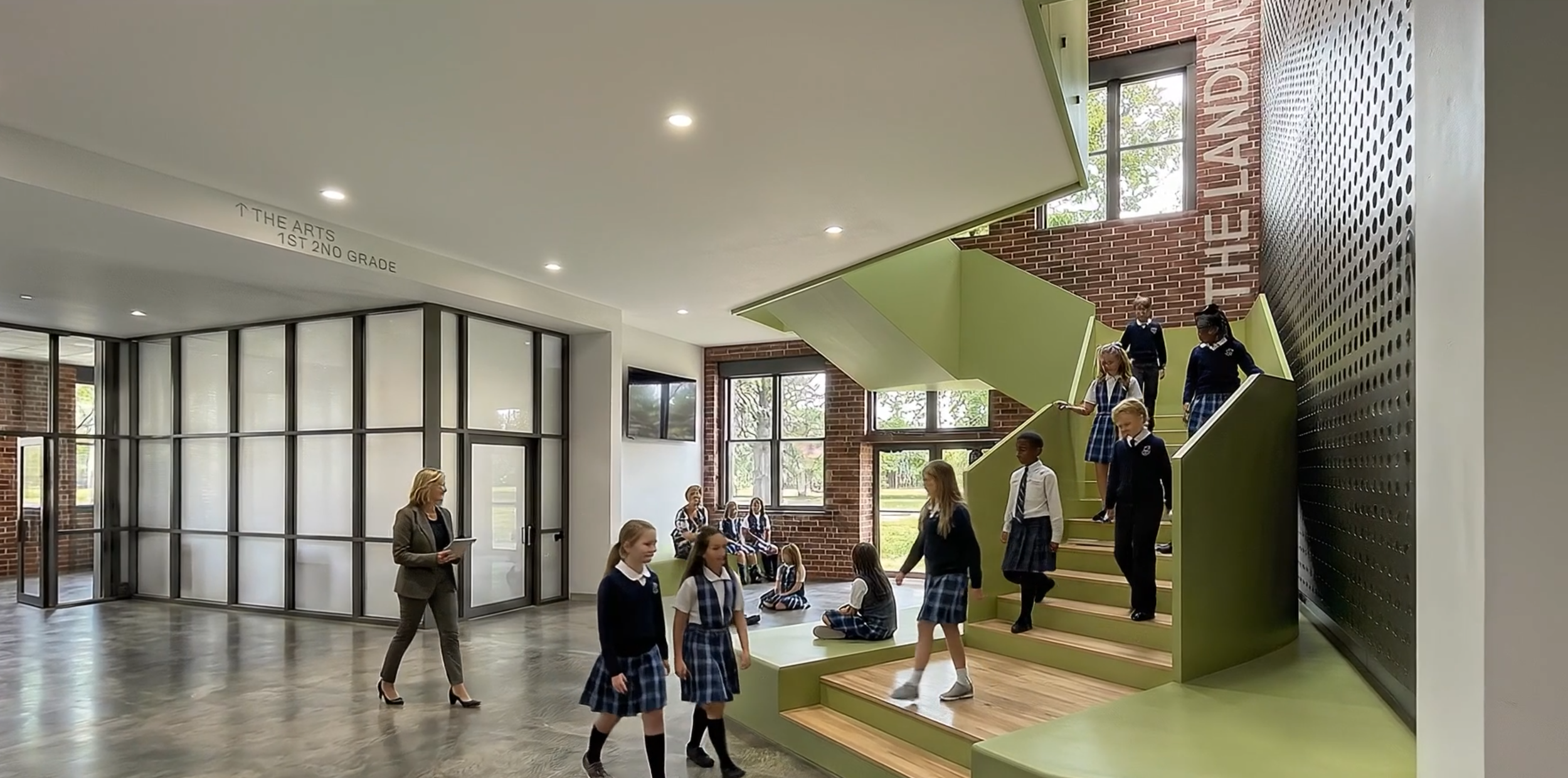
That hospitality extends into the interior life of the school. Catholic education today requires more than conventional classrooms aligned along static corridors. It calls for environments capable of supporting a range of pedagogical models, including direct instruction, collaborative learning, project-based exploration, peer-to-peer engagement, and independent study. Mission Grammar’s renewed campus responds to this reality by treating learning spaces as part of an interconnected educational ensemble. Flexible meeting areas, shared commons, and informal gathering spaces are woven into the life of the building, creating settings that encourage dialogue, adaptability, and interaction.
These spaces are not only educationally effective. They are formative. They reinforce the idea that learning is relational and that formation occurs through encounter as much as instruction. In a Catholic context, this dimension is especially important. Faith is lived in community. It is expressed through participation, service, and shared life. When architecture supports these patterns of engagement, it becomes an extension of the school’s mission. At Mission Grammar, the design is guided by themes of nurture, guidance, and growth, establishing a physical environment that helps scholars understand education not simply as academic advancement, but as the formation of the whole person.
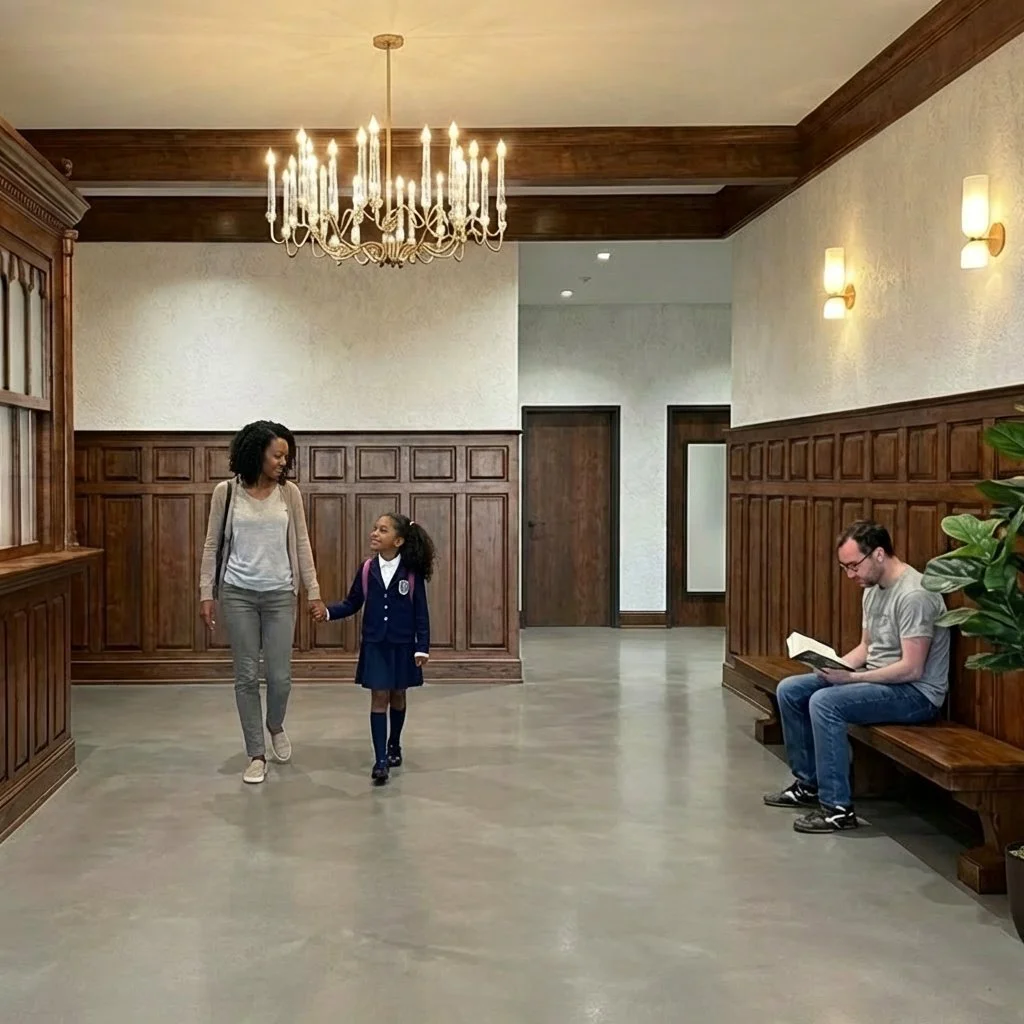
The project’s early education component makes this commitment especially tangible. The lower level introduces a fully renovated early education center with its own entry and drop-off sequence, creating a secure, welcoming, and age-appropriate environment for the school’s youngest learners and their families. New infant and toddler rooms, dedicated restrooms, and a carefully framed reception and lobby area underscore the importance of care, continuity, and first impressions. These spaces communicate that the formative experience of education begins long before formal academics, and that design can play a profound role in establishing trust, comfort, and belonging from the earliest years.
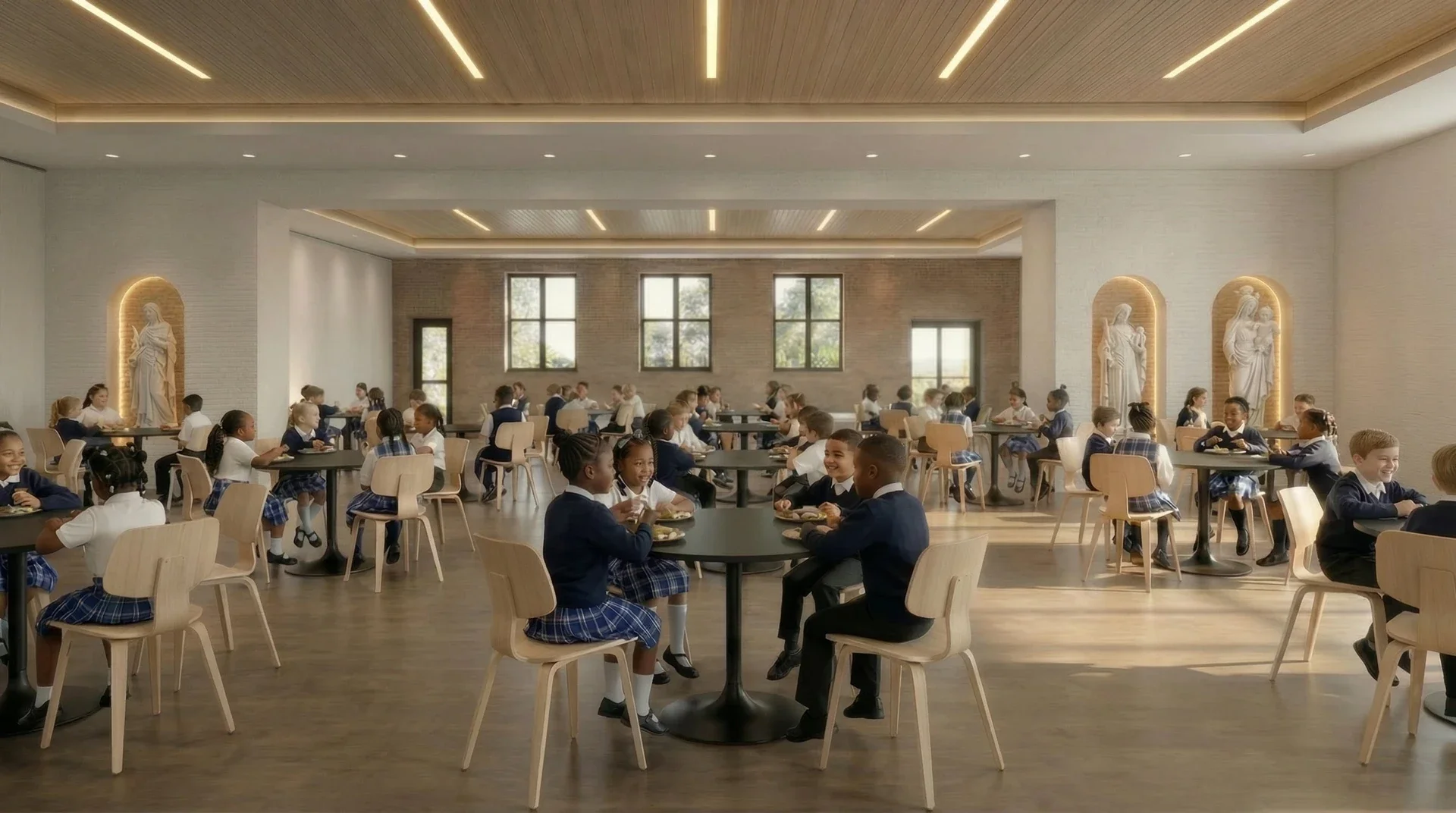
Mission Hall
The project also recognizes that the role of a school extends beyond the classroom. Especially in dense urban neighborhoods, educational institutions often function as civic anchors and gathering places for multiple constituencies. Mission Hall is a powerful expression of that broader role. Envisioned as a flexible venue for both school and parish life, it includes seating for 150 guests, an operable glass façade opening to the Priest Garden, an indoor-outdoor stage, and the support spaces necessary for events, performances, celebrations, and meetings. In restoring a place for communal assembly, the project strengthens Mission Grammar’s ability to serve not only its scholars, but the wider Mission Hill community.
Equally important is the project’s attention to physical well-being. On a land-locked urban campus with limited outdoor space, opportunities for recreation and exercise are constrained. Mission Grammar currently has only one small playground serving all scholars, and access to nearby shared facilities often comes with logistical limitations. The addition of a new gymnasium therefore represents a critical investment in the full development of students. Designed to support athletics, physical education, recess, and major school gatherings, the space reflects a holistic understanding of student success. Intellectual growth, physical health, and social development are not separate priorities. They are interdependent, and the school environment must support them together.
What makes the March 5 groundbreaking particularly meaningful is that it marks the start of only the first phase of a larger, multi-phase vision. Transformative school design rarely occurs through a single gesture. It unfolds through disciplined planning, long-term commitment, and a willingness to invest strategically over time. Each phase of the Mission Grammar project contributes to a broader framework for renewal, one that allows the institution to evolve without losing its essential character. In that sense, the groundbreaking was not just a milestone in construction. It was a statement of confidence in the future.
For MKC Architects, it is a privilege to help shape that future at a moment when our new Boston office allows us to be more deeply present in the city and more directly engaged with the institutions we serve there. Mission Grammar stands as a reminder that the design of a school is never only about buildings. It is about people, memory, formation, and the values a community chooses to carry forward.
As the first phase now moves from aspiration to reality, Mission Grammar offers a compelling example of how thoughtful design can renew not just a campus, but a civic and spiritual institution. It can strengthen identity, enrich learning, support the whole child, and create spaces where faith, education, and community continue to flourish together. The groundbreaking on March 5 was the beginning of construction, but more importantly, it was the beginning of a renewed promise to the community Mission Grammar has served for generations.